
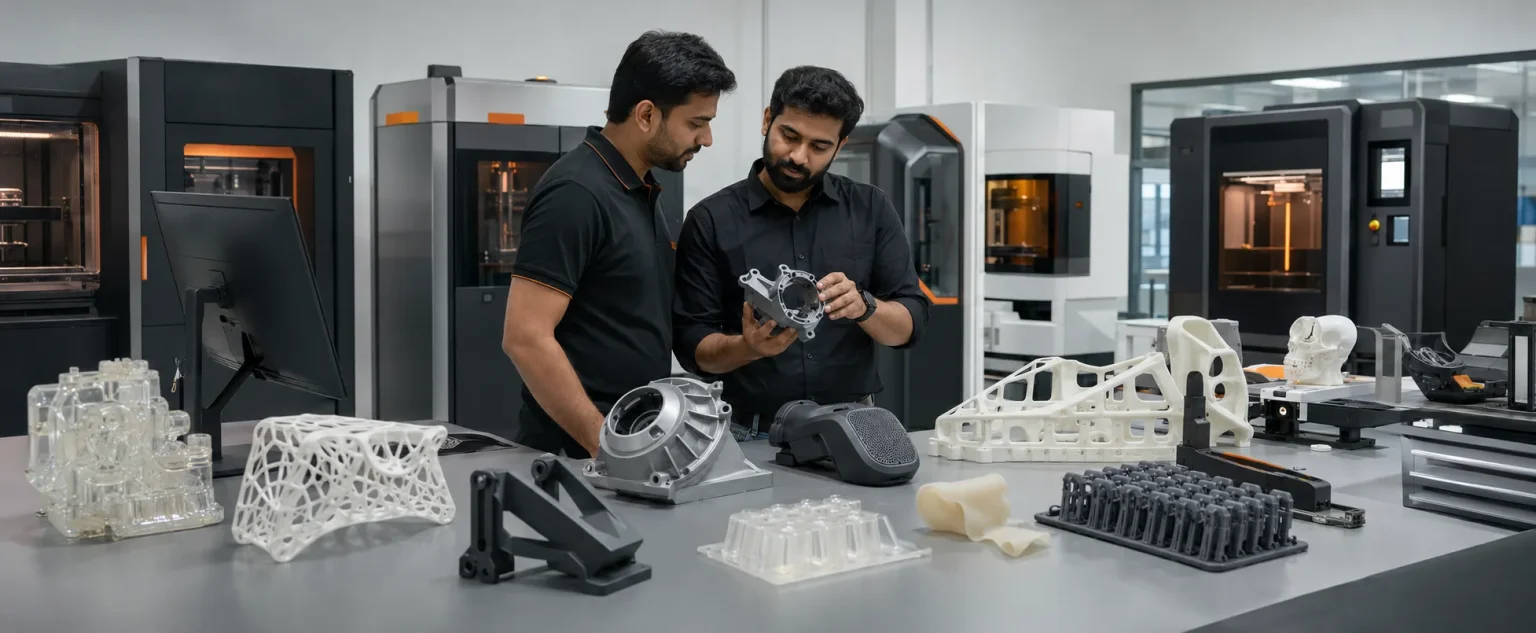
3D printing helps teams turn a CAD file into a usable physical part, which can be a functional part, prototype, end use part, presentation model, fixture, or short batch production part. The main advantages of using 3D printed parts are quick iterations, accurate and functional parts that are not limited by tool or die constraints, and no investment required in tooling.
A good service partner reviews the data, understands the application, recommends the right 3D printing technology, chooses the most suitable material, plans finishing, and helps the team avoid a part that looks printable but fails the real job.
This guide is for product teams, design engineers, founders, procurement teams, and manufacturers who need a practical view of additive manufacturing before they request a quote.
Quick Answer
3D printing turns a CAD file into a physical part that can serve as a functional part, prototype, end use part, presentation model, fixture, or short batch production part. The main advantages are quick iterations, accurate and functional parts not limited by tool or die constraints, and no tooling investment. A good service partner reviews the data, understands the application, recommends the right technology, chooses the most suitable material, plans finishing, and helps the team avoid a part that looks printable but fails the real job.
Why 3D Printing Matters
- Quick iterations during product development.
- Accurate and functional parts that are not limited by tool or die constraints.
- No investment required in tooling.
- Supports concept reviews, ergonomic checks, fitment trials, assembly studies, and visual approvals before spending on tooling, casting, or full production.
- The same supplier can support bridge quantities, pilot batches, presentation sets, and manufacturing aids once the design settles.
The Process
A professional 3D printing workflow starts before the machine runs. The supplier should first understand what the part must prove. A concept model needs speed and basic form. A customer-facing sample needs a cleaner surface. A functional part may need strength, snap-fit behaviour, and controlled tolerances.
Early discussion saves time and cost because it separates the design question from the production method. Instead of forcing every job through one familiar process, the supplier can choose the route that fits the geometry, quantity, finish, and deadline.
| Stage | What happens | Why it matters |
|---|---|---|
| File review | The CAD file is checked for wall thickness, weak areas, holes, scale, and build risks. | The team can fix preventable issues before the first build. |
| Process selection | SLA, SLS, MJF, DLP, FDM, metal additive, CNC, or vacuum casting may be compared. | The process is matched to its real purpose. |
| Material selection | The supplier checks whether the part needs cosmetic, heat, impact, chemical, or flexible performance. | Material choice affects strength, finish, and other parameters. |
| Build planning | Orientation, support strategy, nesting, and batch planning are decided. | Planning affects finish, accuracy, repeatability, and wastage. |
| Finishing and inspection | The part may be sanded, painted, vapour smoothed, fitted with inserts, threaded. Finally inspection is done. | The finished result is judged against the use case, not just against print completion. |
Where Excel Rapidtech Fits
Most projects begin in product development. Teams use printed parts for concept reviews, ergonomic checks, fitment trials, assembly studies, and visual approvals. These parts help teams test a decision before they spend on tooling, casting, or full production.
The next use case is functional validation. Brackets, housings, fixtures, jigs, ducting, covers, and low-stress mechanical parts can often be built quickly enough to support design learning. Once the design settles, the same supplier can support bridge quantities, pilot batches, presentation sets, and manufacturing aids through a broader 3D printing services workflow.
A good supplier guides the customer correctly. The goal is not to print every part. The goal is to choose the manufacturing route that helps the project move forward to the next stage. Excel Rapid Tech also lists other manufacturing and post-processing services for projects that need a different route.
Comparison: 3D Printing Technologies
The best process depends on the question the part must answer. Surface finish, toughness, detail, part size, repeatability, and cost all influence the choice.
| Technology | Best fit | Watch for |
|---|---|---|
| SLA | Appearance models, sharp details, smooth prototypes, high accuracy, form studies. | SLA parts may not behave like final production plastic in load or heat tests. Low durability. |
| DLP | Small resin parts, fine details, efficient batches when the build size fits, high accuracy. | Build volume and resin behaviour can limit larger industrial parts. |
| SLS | Functional and production grade nylon parts, high strength, snap fits, complex shapes, housings, ducts, brackets. | Textured surface finish unless post processing is done. |
| MJF | Consistent nylon parts, medium batches, practical strength, repeatable functional components. | Colour and surface finish expectations should be discussed. |
| FDM | Low-cost concept models, large draft parts, fixtures, and quick internal checks. | Layer lines, lower cosmetic quality, low accuracy. |
| Metal additive | Complex metal features, lightweight internal structures, and design trials before machining or casting. | Cost, material certification, and inspection requirements need a stricter review. |
How to Choose the Most Suitable Material
Material choice should not start with a catalogue. It should start with the application of the part. A desk review model may only need a clean surface. A clip, duct, or bracket may need impact strength, flexibility, or stable dimensions. A part near heat, chemicals, vibration, or repeated handling needs a more serious material discussion.
For many teams, the practical question is whether the printed part must only explain the design or whether it must behave close to the final product. That difference changes the process, material, finishing and price. Review the technology selection guide for engineers when comparing processes for a specific application.
Step-by-Step Workflow
- File review: the CAD file is checked for wall thickness, weak areas, holes, scale, and build risks.
- Process selection: SLA, SLS, MJF, DLP, FDM, metal additive, CNC, or vacuum casting are compared.
- Material selection: the supplier checks whether the part needs cosmetic, heat, impact, chemical, or flexible performance.
- Build planning: orientation, support strategy, nesting, and batch planning are decided.
- Finishing and inspection: the part may be sanded, painted, vapour smoothed, fitted with inserts, threaded, and finally inspected.
Common Mistakes to Avoid
- Choosing a process because it is familiar instead of choosing the process that matches the use case.
- Sending a file without detailing the expectations such as tolerances, finish level, etc.
- Asking for a rush quote before quantity, delivery location, and finishing needs are clear.
- Treating post-processing as a small add-on when appearance or assembly quality matters.
- Ignoring how the prototype result will influence the next manufacturing step.
What to Measure
- A clean CAD file in STEP or STL format.
- Expected quantity, including whether you need one part, a short batch, or staged delivery.
- Application of the part.
- Material expectation, especially if the part needs heat, impact, chemical, or cosmetic performance.
- Critical dimensions, assembly interfaces, and surfaces that cannot be freely reworked.
- Finishing requirements such as painting, smoothening, inserts, threading, etc.
- Target delivery date, delivery destination, and other such practical information.
When 3D Printing Is Not the Right Answer
3D printing is not bound by tooling limitations, but it does not replace every manufacturing route. CNC machining may be better when tight tolerances, specific material grades, or machined surfaces are the priority. Vacuum casting can work better for realistic low-volume plastic parts when cost matters. Hard tooling becomes more sensible when volumes, repeatability, and unit economics justify the setup cost.
Conclusion
A good supplier will guide their customer correctly. The goal is not to print every part. The goal is to choose the manufacturing route that helps the project move forward to the next stage. To discuss a specific application, share the CAD file, expected quantity, material requirement, finish, tolerances and delivery timeline through the Excel Rapid Tech contact page.
Ready to discuss your part?
FAQs
What do 3D printing services usually include?
They usually include CAD review, process selection, material guidance, build planning, post-processing, inspection, packing, and delivery. Some suppliers also support design improvement, CNC machining, vacuum casting, and assembly work.
How do I know if my part is ready to quote?
A part is ready to be quoted when you can share the CAD file, quantity, material requirements, finish needs, tolerances and critical dimensions. The brief does not need to be perfect, but it should be clear enough for a technical review.
Which technology is best for prototypes?
There is no single best technology. The right choice depends on what the prototype must prove.
Can one supplier support different stages of the same project?
Yes. That is often easier because the learning from each round stays visible. A team may start with a visual model, move to a functional part, then order a short batch or manufacturing aids through the same technical partner.
Related Reading
- Which 3D Printing Technology Should You Choose? A Guide for Engineers
- 3D Printing Services in India: SLA vs SLS vs MJF vs DLP
- 3D Printing Services in India: Cost, Lead Time and RFQ Checklist
- End-to-End 3D Printing Services for Engineers and Manufacturers
- In-House 3D Printing vs a Professional 3D Printing Service: Which Is Better?