
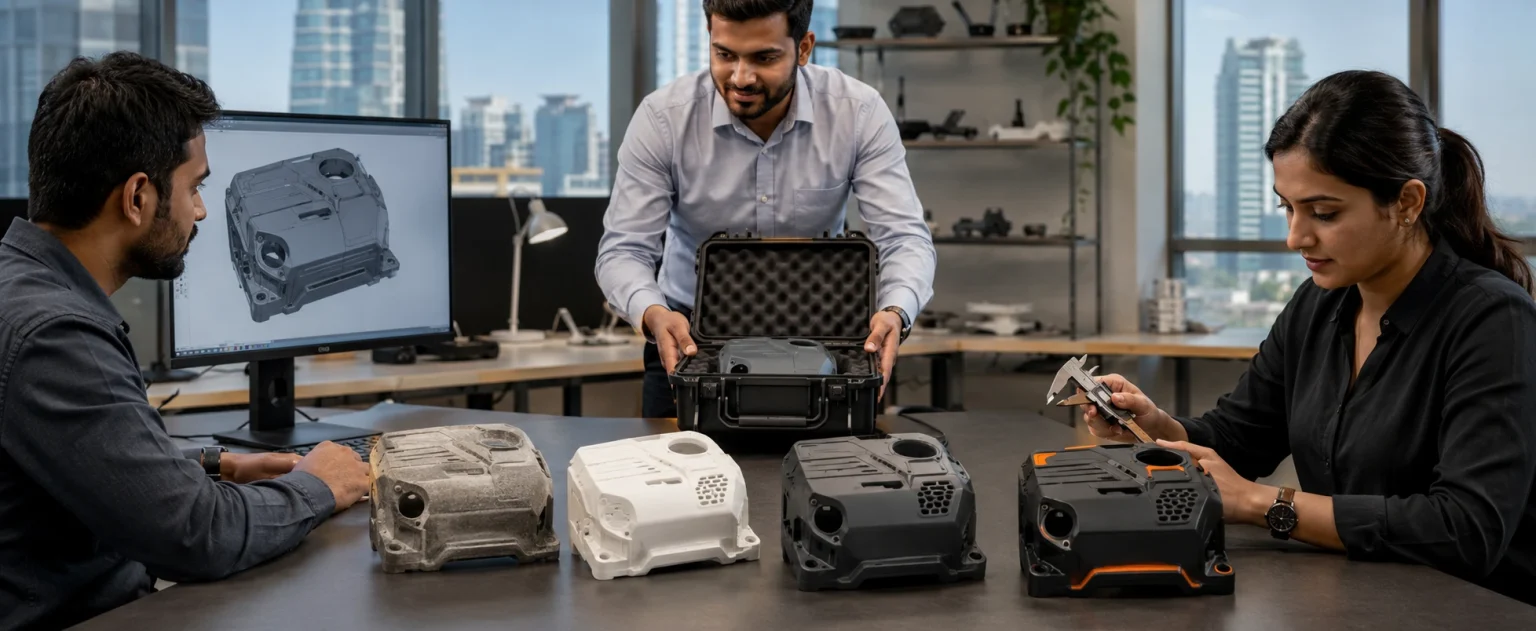
Engineering teams need frequent iterations, but buying one printer does not automatically provide industrial materials, multiple technologies, finishing, inspection or capacity. A disciplined outsourced workflow can keep revisions fast. This article explains how professional 3D printing in Gurgaon should be evaluated from the customer-problem, engineering-decision and commercial-buyer perspectives. It also shows what information should be shared with a professional manufacturing partner so the quotation, process and final part are aligned with the real project objective.
Professional 3D printing in Gurgaon is most useful when it is selected around a real engineering and commercial objective. This guide explains the practical decisions product teams, engineers and procurement teams should make before approving the next manufacturing step.
Quick Answer
Gurgaon engineering teams can manage fast prototype revisions without buying a 3D printer by creating a revision protocol, defining what changed, using partial prototypes, keeping acceptance criteria stable, setting design-freeze gates and evaluating the commercial model — relying on a disciplined outsourced workflow across professional 3D printing and low-volume processes.
Why a Revision Workflow Matters
- An in-house printer may produce basic models quickly, but industrial prototyping also requires process selection, material knowledge, maintenance, finishing, inspection and capacity planning.
- Outsourcing can be more suitable when requirements vary across projects.
- Clear file names, revision numbers and a written change log prevent a supplier from producing an earlier version.
- When only one interface changes, printing the affected section or a simplified test fixture can reduce lead time and help the team isolate the problem.
- Measuring the same critical dimensions and repeating the same functional check across revisions reveals whether the design actually improved.
- Frequent printing can become a substitute for decision-making — set clear gates for concept approval, fitment approval, functional approval and pilot production.
Where Excel Rapidtech Fits
Excel Rapidtech can support Gurgaon engineering teams with managed prototype revisions across suitable 3D printing and low-volume processes. A disciplined brief and review cycle can make outsourced iteration fast and measurable. The company can review the CAD model, application, quantity, material expectation, finish and critical dimensions before recommending a suitable route, with a wider service structure covering 3D printing, SLA, SLS, vacuum casting, CNC machining, design support and post-processing.
Comparison
| Decision area | Option or condition A | Option or condition B |
|---|---|---|
| File control | Revision number and approved manufacturing file | |
| Change log | Geometry, tolerance, material and finish changes | |
| Test plan | Same checks across versions | |
| Build scope | Partial interface or complete assembly | |
| Commercial review | Equipment, labour, failure, finishing and utilisation |
Key Factors
The following factors should be reviewed together. Optimising one in isolation can create a new problem elsewhere in the project.
- Revision control. Define the requirement in measurable terms and explain how it affects the intended test, assembly or production decision.
- Change description. Define the requirement in measurable terms and explain how it affects the intended test, assembly or production decision.
- Partial versus full builds. Define the requirement in measurable terms and explain how it affects the intended test, assembly or production decision.
- Consistent acceptance test. Define the requirement in measurable terms and explain how it affects the intended test, assembly or production decision.
- Cost of ownership versus service. Define the requirement in measurable terms and explain how it affects the intended test, assembly or production decision.
Step-by-Step Workflow
- Define the business decision the part must support. Examples include design approval, fitment validation, customer trial, tooling release or a limited pilot batch.
- Identify the technical risks. Mark interfaces, critical dimensions, loads, environmental exposure, visible surfaces and features that may fail during assembly.
- Select the process around those risks. Compare geometry, material behaviour, quantity, finish and design stability rather than choosing only by familiarity or lowest price.
- Agree on acceptance criteria. State what will be measured, assembled, tested or visually approved before the part is accepted.
- Control revisions and approvals. Use a clear file number, record feedback and freeze the approved version before the next manufacturing stage.
Common Mistakes to Avoid
- Emailing files with vague names.
- Reprinting the whole assembly for a local change.
- Changing the test method between revisions.
- Continuing iterations without a design-freeze gate.
- Comparing service price only with machine purchase price.
What to Measure
- CAD revision number matched to the approved manufacturing file.
- Critical dimensions measured against the same tolerances across revisions.
- The same functional checks repeated on every version.
- Build scope — partial interface versus complete assembly — justified for each iteration.
- Total cost of ownership compared with professional service cost, including equipment, labour, failures, finishing and utilisation.
How to Choose a Professional 3D Printing Process
The best process depends on what the prototype must prove. SLA is commonly selected when fine details and a smooth surface are important. SLS is often preferred for complex nylon parts, clips and functional assemblies. Vacuum casting may follow a finished master when several similar polymer parts are required. CNC machining may be more appropriate where the design, material or tolerance is better served by subtractive manufacturing. A professional provider should explain the trade-off instead of recommending the same technology for every file.
Factors That Affect Cost and Delivery
Price and lead time are shaped by part size, build volume, orientation, material, quantity, support removal, surface finishing, painting, assembly and inspection. File problems and unclear requirements can cause more delay than the print itself. Buyers should provide a complete technical brief and respond quickly to manufacturability questions. For local projects, proximity can simplify communication and collection, but it does not replace technical planning or quality control.
What to Include in a Quotation Request
Share the preferred file format, quantity, application, target material behaviour, critical dimensions, tolerance where genuinely required, surface finish, colour and delivery requirement. State whether the part is for appearance, fit, assembly, function or a pilot batch. Include drawings and mating components where possible. This reduces ambiguous assumptions and makes supplier quotations easier to compare.
How to Compare Local 3D Printing Suppliers
Compare process range, engineering review, material information, finishing, inspection, confidentiality, revision control and communication. Ask whether the supplier can explain why a process is suitable for the application. Review what is included in the quotation and whether critical dimensions will be checked. A professional service should help reduce project risk, not merely convert file volume into a price.
Conclusion
The right use of professional 3D printing in Gurgaon begins with a clearly defined problem and ends with an evidence-based manufacturing decision. Buyers should connect design maturity, geometry, material behaviour, quantity, finish, inspection and commercial risk instead of selecting a process only by unit price. A detailed brief makes quotations more comparable and helps the manufactured part answer the question it was created to test. Share your CAD file, required quantity, application, critical dimensions and finish expectations with Excel Rapidtech for a technical feasibility review.
Ready to discuss your part?
FAQs
Is buying a 3D printer necessary for fast prototype revisions?
No. Buying one printer does not automatically provide industrial materials, multiple technologies, finishing, inspection or capacity. An in-house printer may produce basic models quickly, but outsourcing can be more suitable when requirements vary across projects.
How can teams prevent a supplier from printing an earlier version?
Use clear file names, revision numbers and a written change log. Mark obsolete files and identify the approved manufacturing file. This prevents a supplier from producing an earlier version.
What should a change description include?
State whether the revision affects geometry, tolerance, material, finish or quantity. A small visible change may require a different build orientation or revalidation of mating features.
When should the design be frozen?
Frequent printing can become a substitute for decision-making. Set clear gates for concept approval, fitment approval, functional approval and pilot production.
How should the commercial model be evaluated?
Compare the cost of equipment, materials, staff time, maintenance, failed builds and limited technology access with the cost of using a professional service. The answer depends on utilisation and the range of parts required.
Why keep acceptance criteria stable across revisions?
Measure the same critical dimensions and repeat the same functional check across revisions. Changing the test method makes it difficult to determine whether the design actually improved.
Related Reading
- In-House 3D Printing vs a Professional 3D Printing Service: Which Is Better?
- How Gurgaon Automotive Teams Can Prototype Components Before Production Tooling
- 3D Printing Services in India: Cost, Lead Time and RFQ Checklist
- How Gurgaon Product Companies Can Choose Between SLA and SLS Prototyping
- How to Validate PCB Fitment, Ports and Screw Bosses with a 3D-Printed Enclosure